Tuesday, July 29, 2025

New Releases - August Edition

Check out these highly anticipated new releases featuring fiction and nonfiction titles. Click on the title to request a copy or get your name on the waitlist. Don’t forget to watch for more featured releases next month!


NONFICTION

Are You Mad at Me?: How to Stop Focusing on What Others Think and Start Living for You by Meg Josephson.  In her first book, psychotherapist Josephson explores people's need to regularly confirm that others aren't angry or upset with them. Explaining that she, too, is a person who feels this need, the author unearths different reasons for why one might fear conflict or be inclined to be a people-pleaser. For example, children who live in homes where they are neglected or where there is a high level of dysfunction and conflict may develop sensitivities to others' moods because it helps keep them safe. Josephson explains that behavior that was once protective may no longer be useful once a person is out of that turbulent environment, and she suggests ways to train oneself out of such reactions, including dealing with thoughts mindfully and working through the pain that led to the need for hypervigilance. Josephson also discusses allowing oneself to feel and acknowledge emotions, how to calm down in moments of high emotion, setting boundaries, and becoming more comfortable with uncomfortable situations. Copyright 2025 Library Journal.

The Martians: The True Story of an Alien Craze That Captured Turn-of-the-century America by David Baron. Decades before Orson Welles's 1938 radio adaptation of H.G. Wells's The War of the Worlds triggered a panic among some unsuspecting listeners who thought Martians were invading the Earth, astronomers such as Percival Lowell, Camille Flammarion, and Giovanni Schiaparelli ushered in a cultural fixation on Mars from 1892 to 1916. Science journalist Baron (American Eclipse) explores the fanciful tales surrounding the debate on whether intelligent beings inhabited Mars. He details how tabloid newspapers and popular culture captured the public's imagination with reports about the astronomers who claimed they observed lines crisscrossing Mars. These lines, they believed, were canals engineered by an advanced civilization. Books, theatrical productions, and public lectures flourished as people eagerly awaited news of their Martian neighbors. Baron explains that even inventors like the eccentric Nikola Tesla attempted to build a behemoth radio tower that could receive signals from Mars. The author further frames the Mars debate and the accompanying mania within life's historical and cultural context at the turn of the century. VERDICT This absorbing, illustrated account will transport science fiction and astronomy buffs back to when people dreamed of life on Mars.—Donna Marie Smith Copyright 2025 Library Journal.

Disney Adults: Exploring and Falling in Love With a Magical Subculture by A.J. Wolfe.  This book, by a proud, self-proclaimed "Disney adult," is written with love and warmth but doesn't shy away from the more negative aspects of what it means to be a fan of the House of Mouse. Wolfe, whose popular website The Disney Food Blog offers news, reviews and information about food and restaurants in Disney's parks, resorts, and cruise ships, brings in her personal experience and the contacts she's made through her site to show the different ways the fandom exists, how people became fans, and the joy it's brought to their lives. Wolfe's book goes into the psychology of the fandom, gives thorough descriptions of the subculture, and compares Disney obsessives to other kinds of fans; throughout, she makes the case that the Disney fandom is no monolith but rather is rife with its own divisions and spin-offs. There are also deep dives into how fans have influenced the Disney company over the last few decades and how changes in media and activism continue to shape Disney and its devotees. There's even a tongue-in-cheek quiz at the end for readers questioning whether they qualify as Disney adults. Copyright 2025 LJExpress.


FICTION

The Magician of Tiger Castle by Louis Sachar.  Children's author Sachar (Holes) makes his adult debut with this cozy fantasy that could also easily be read by teens. Immortal magician Anatole, living in the present, relates a story from his past, when he was a floundering magician to the king of a small kingdom in the south of France in the 1500s. To secure a much-needed alliance, Princess Tullia is betrothed to the prince of a nearby kingdom, but she falls in love with an apprentice scribe, Pito. The king charges Anatole with making Tullia agree to marry the prince, which Anatole hopes to do by crafting a memory potion that will make Tullia forget Pito. However, Anatole must decide whether to save the marriage, the kingdom, and his career or help Tullia and Pito. While an interesting frame to the story, the jumps between past and present in Anatole's narration can be confusing and jarring to the flow of the novel. VERDICT Sachar writes an engaging story from a magician's perspective that feels adjacent to a fairy tale.—Leigh Verburg
Copyright 2025 Library Journal.

When the Cranes Fly South by Lisa Ridzén.  Bo Andersson is an older man living alone with his beloved dog, Sixten, an elkhound who watches his every move. Bo's wife, Fredrika, is a dementia patient who lives in a nursing home. Depending on his work schedule, Bo's divorced adult son Hans visits him weekly. Daily, caregivers come to Bo's house to help with meals and showers, while Hans wants his father to rehome Sixten with another family because he fears that Bo might fall while taking the dog for walks. Ridzén's engaging novel (Sweden's Book of the Year in 2024) delves into Bo's memories, his disagreements with Hans, and his telephone conversations with his friend Ture, who has his own medical challenges. This moving and crowd-pleasing novel gently depicts aging and its joys and sadnesses through a protagonist who misses his wife and wishes he were not so old but enjoys spending his remaining days with his dog. VERDICT Readers will laugh and cry. In Bo, Ridzén has created a character who can evoke empathy in anyone.—Joyce Sparrow, Copyright 2025 Library Journal.

Indian Country by Shobha Rao.  An immigrant couple finds America a mystery, in more ways than one. Rao’s second novel—following Girls Burn Brighter (2018)—concerns Sagar and Janavi, a young couple from Varanasi, a town on the banks of the Ganges River. Thrust into an arranged marriage, the two are ambitious yet uncertain of each other—Sagar is a hydraulic engineer, Janavi a worker supporting children in crisis. So, when Sagar lands a civil-service job in Montana, where he’s charged to coordinate the removal of a dam on the Cotton River, trading in a bustling Indian city for Big Sky Country is both a geographic and cultural change. Both experience racist microagressions from the locals, but both also find common ground with them: Janavi in learning about the often troubled women in the area, and Sagar discovering the Native American lore surrounding the river and its echoes of Indian lore. One of the people sharing that world with him is Renny, one of the workers on the dam-removal crew, and in due time Sagar is embroiled in a murder mystery involving tribal history, scapegoating, and an orphaned child. Rao’s novel . . .admirably undoes the conventions of the assimilation novel, focusing less on how Sagar and Janavi fit into their new country than on ways they find human connection outside of the notions of being an American.  A lyrical and propulsive story that makes the most of its double-edged title. Copyright 2025 Kirkus/BPI Communications. All rights reserved.


Tales of Branch Libraries Past: The Quinsigamond Branch

We have previously highlighted the history of the Frances Perkins Branch Library (formerly known as the Greendale Branch) and the now-closed South Worcester Branch, but what do you know about the third branch library that was funded by steel tycoon and philanthropist Andrew Carnegie? Behold, the Quinsigamond Branch, a beloved branch located at 812 Millbury Street whose building found a new life after it closed in 1990.

Quinsigamond Branch Library - Children's Area, circa 1940s
The Backstory

Library services first officially came to Quinsigamond Village in May 1898 when the city council funded eight delivery stations around the expanding city, including a delivery station housed in Anderson Bros. (a men's furnishing goods store) at 882 Millbury Street. By 1910, Mayor James Logan requested funds from Andrew Carnegie to build three library branches and received communication from Carnegie's representative agreeing to contribute $25,000 each for three branches with the condition that the city provided the properties and contributed a maintenance fund.

The American Steel & Wire Co., a major employer in the Quinsigamond Village community, deeded land to the city for the creation of the Quinsigamond Branch in 1911. The branch would be located next to the Quinsigamond Street School at the corner of Millbury and Stebbins Streets. By November 1912, the city sent plans for the three branches to Andrew Carnegie, including the Quinsigamond Branch plans drafted by the architect company Fuller & Delano Co. After the plans were approved, eight contractors bid for the contract to construct the Quinsigamond Branch with John J. Power winning the contract with the lowest bid of $20,800.

As we wrote in previous blog posts, Andrew Carnegie and his wife visited Worcester on March 26, 1913 to lay the cornerstones at the three branches. Quinsigamond Branch hosted the second ceremony of the day, which was immediately preceded by Carnegie's unexpected but necessary stop at the First Cooperative grocery store to purchase weatherproof shoes for himself on that muddy March day. 

Carnegie Invests Part of Fortune for Little Rubbers in Quinsigamond, Worcester Telegram,
March 27, 1913

The Worcester Evening Gazette wrote about the features of the almost completed building in their August 2, 1913 issue. For instance, the one-story Quinsigamond Branch was designed in the Grecian style, with a Barrington (RI) brick facade and Indiana limestone trimmings. The right side of the building would house the reading room and the left side would house the reference and children's reading rooms.

Quinsigamond Branch Library Nearly Ready, Worcester Evening Gazette, August 2, 1913

Six months later, the new branch was ready to open to the public. Approximately 200 people attended the dedication on the evening of February 23, 1914, with speeches from Judge F.H. Chamberlain of the library board of trustees; Head Librarian Robert K. Shaw; Reverend Carl A Seaberg of the Quinsigamond Swedish Methodist Church; and George Rugg, the principal of the neighboring Quinsigamond Street School. The branch opened for business the following day, with Miss Madeline Bell at the helm. 

Opens Library to Public at Quinsigamond, Worcester Telegram, February 24, 1914
The Early Years

In February 1916, Miss Bell transferred to the Main Library to be the head of the children's department and Miss Cecile Houghton, formerly a cataloging librarian at the Main Library, took over as head of the Quinsigamond Branch. Miss Houghton, who would be in charge of the branch for 12 years before departing to the Greendale Branch in 1928, was instrumental in making the library a welcoming place for the community during those early years. For instance, in 1916, the branch opened during the noon hour because the employees of the nearby American Steel & Wire Co. asked to be able to visit the library during their dinner break.

During the first couple of decades, the branch catered to the large Swedish population in Quinsigamond Village by providing regularly published newspapers and books in Swedish (originally printed in Swedish as well as books translated from English). The library also offered canning and bread-making demonstrations for the Polish and Lithuanian women in the neighborhood. By 1938, the Worcester Evening Gazette reported that the Quinsigamond Branch carried books in four foreign languages. 

Bread Demonstration to be Given in Quinsig, Worcester Telegram, April 4, 1919

The children in the neighborhood, including the elementary school children at the school next door, visited the library to read books, attend programs, participate in contests, and even perform in plays! Librarians organized a boys' library club and a girls' library club within two years of the opening of the branch to help keep the neighborhood children off the streets and out of trouble. One highlight of the Quinsigamond Branch in 1923 was a pair of performances of the Library Girls' Club production of "Helga and the White Peacock" by Cornelia Meigs. Proceeds were allocated to purchasing an "object of art" for the library. Miss Houghton helped coach the young actors and helped design the costumes.

"Library Girls' Club Dramatics - The White Peacock - Meigs," 1923

One hugely popular long-running program held at the Quinsigamond Branch for 35 years was the annual Doll Festival inspired by the Japanese tradition. The branch held this event every year from 1919 to 1955 where librarians would read stories to the children and little girls would bring their dolls to exhibit. Prizes were awarded for several categories, including a category of dolls wearing clothes made by the doll's owner; rag dolls; baby dolls; dolls from other countries or unusual dolls; dolls over 24" high, and dolls under 24" high.

Winners at Doll Festival, Worcester Sunday Telegram, March 29, 1942

Library is 48 Years Old, Worcester Evening Gazette, April 3, 1961
Fast Forward to the 1970s...

And so life at the library continued, until municipal budget cuts in 1976 affected the Quinsigamond Branch like the rest of Worcester Public Library. The Quinsigamond Branch closed for two months starting in June 1976 in preparation for the relocation of the regional film library and talking book service from the Main Library. The regular public library space at the branch would be a quarter of its previous size after the renovations but the reconfiguration of the branch to the new Film and Talking Book Library would help keep the branch open with more hours than the previous year. The regional film service was available to Worcester County residents ages 18+ and as of 1977, contained 1850 titles (which at the time ran on film projectors). A second regional film service was housed at the Fitchburg Public Library.
Film Service is Doing Brisk Business, Worcester Evening Gazette, August 26, 1977

The Talking Book Library (which officially started in 1973 at the Main Library and will be the subject of a future blog post!) served the blind and physically handicapped residents of the then-70 towns in the Central Massachusetts Regional Library System. The Main Library added a public service area for patrons of the Talking Book Library in 1983. 

Quinsigamond Branch, circa 1978

Both of the regional film collections at Quinsigamond Branch and at the Fitchburg Public Library consolidated when they moved to an office in Holden in 1986. The Talking Book Library also moved in 1986 from the Quinsigamond Branch to the Main South Branch building when Main South Branch opened in its new location. The relocation of the film collection and the Talking Book Library, along with additional funding made it possible to eventually resume more public library services at the Quinsigamond Branch but the library was forced to decrease the number of hours that it was open.

The End of the Quinsigamond Branch...and New Beginnings

The end of the Quinsigamond Branch came in 1990 when all of the Worcester Public Library branches closed due to the Proposition 2 1/2 budget cuts. The Quinsigamond Branch never reopened as a library, unlike the Great Brook Valley Branch, which reopened within a couple of months and the Greendale Branch (now known as the Frances Perkins Branch), which reopened in 1992. Initially, the University of Massachusetts Cooperative Service Extension leased the building for a period of time. Then in February 1993, the Worcester Public Library board voted to turn the former branch property over to the city so that the new Quinsigamond School could be built using that property. The original Quinsigamond School had closed at the end of the 1992-1993 school year due to physical deterioration and the neighborhood desperately needed a new school building. 

However, there was a hitch in the plans to build the new school: the Quinsigamond Branch (and the other two Carnegie branches in Worcester) had been added to the National Register of Historic Places in March 1980. It turns out that there are rules in place for when people want to alter or even demolish a building that is on the National Register of Historic Places. In this case, the city needed to submit an environmental impact report on the new building project to the state Environmental Protection Agency unless they could secure a waiver. In the meantime, Preservation Worcester and other advocates called for the preservation of the historic library branch building. The waiver was denied in August 1993 and the new school building project delayed (in the meantime, students attended the Vernon Street School). 

Quinsig School Battle Flares Again, Worcester Magazine, January 5, 1994

In January 1994, Preservation Worcester announced they would not block the building of the school, although they hoped that the library branch building could be incorporated into the design instead of being demolished. In March of the same year, the city announced they had reached a deal that would incorporate the library branch building's shell and a section of the old Quinsigamond School into the new school building design. In return, the city would not have to file a supplemental environmental impact report or go through an appeal process. Construction on the new Quinsigamond School began in 1995 and the new school building finally opened in the fall of 1997, with the historic Quinsigamond Branch building's shell incorporated into the new structure as a cafeteria.

Quinsigamond Branch Library, circa 2011, Image credit: Pvmoutside

Sources:

"Branch Plans Present are Sent to Andrew Carnegie." (1912, November 16). Worcester Telegram, p. 1.

"Bread Demonstration to be Given in Quinsig." (1919, April 4). Worcester Telegram, p. 2.

Bunnewith, M.J. (1994, January 22). "Preservation Group Won't Block School." Worcester Telegram & Gazette, p. A2.

"Carnegie Invests Part of Fortune for Little Rubbers in Quinsigamond." (1913, March 27). Worcester Telegram, p. 16.

Collier, G.A. (1991, November 1). "Library Offering to Rent Two Libraries." Worcester Telegram & Gazette, p. A2.

Crockett, W. (1994, January 5). "Quinsig School Battle Flares Again." Worcester Magazine, p. 7.

Farson, S. (1979, September 9). "Films a Major Library Service." Worcester Telegram, p. 28.

"Film Collection to be Relocated." (1976, June 19). Worcester Evening Gazette, p. 8.

"Girls Library Club." (1916, March 10). Worcester Telegram, p. 2.

Hammel, L. (1994, March 15). "New Plan Spares Quinsig Library \ School Proposal OK for Now." Worcester Telegram & Gazette, p. B1.

"'Helga and the White Peacock' Wins Its Juvenile Audience to Smiles and Tears." (1923, May 23). Worcester Telegram, p. 4.

Kotsopoulos, N. (1993, February 17). "'Hub Suburb' Notion Rankles \ Council Brittles at OMB Changes." Worcester Telegram & Gazette, p. B1.

Lazure, L. (1977, August 26). "Film Service is Doing Brisk Business." Worcester Evening Gazette, p. 8.

"Librarian is Given Farewell Luncheon." (1928, February 9). Worcester Evening Gazette, p. 14.

"Mayor Approves Library Contract." (1913, February 1). Worcester Evening Gazette, p. 3.

"Miss Cecile Houghton is Appointed Head of the Branch Library at Quinsigamond." (1916, February 20). Worcester Sunday Telegram, p. 12.

Nangle, R. (1993, August 25). "Durkin School Waiver Denied." Worcester Telegram & Gazette, p. B1.

"Opens Library to Public at Quinsigamond." (1914, February 24). Worcester Telegram, p. 1.

"Polish-Speaking Women to Get Demonstration." (1918, July 31). Worcester Telegram, p. 6.

"Public Library Contains Books in 24 Languages." (1938, July 16). Worcester Evening Gazette, p. 13.

"Quinsigamond Branch Library Nearly Ready." (1913, August 2). Worcester Evening Gazette, p. 13.

"Quinsigamond Library to be Open During the Noon Hour." (1916, October 11). Worcester Telegram, p. 2.

"Winners at Doll Festival." (1942, March 29). Worcester Sunday Telegram, p. 19.


Tuesday, July 22, 2025

Tales of Branch Libraries Past: The Billings Square Branch

We have previously shared the origins of the Main Library and the three branches funded by Andrew Carnegie (we will have a more in-depth post about the Quinsigamond Branch at a later date) but today we are going to highlight the fourth branch of Worcester Public Library, the now-closed Billings Square Branch. This branch had the honor of being the first WPL branch funded by the city budget.

A Little Backstory...
The residents of Worcester still hungered for local library services in their own neighborhoods even after the three Carnegie branches opened in the Greendale, Quinsigamond, and South Worcester areas. As mentioned in previous posts, the Worcester Public Library used delivery stations in private houses and stores to fill the needs of the expanding city prior to the opening of those branches. In fact, many of the delivery stations and school deposits actually continued beyond the branch openings in 1914! According to a 1961 history of the Billing Square Branch, Worcester Public Library continued to contribute materials to several delivery stations as well as school services (small collections of library materials housed in schoolrooms, with periodic refreshing of the collections) and deposit services in factories and other locations. However, the delivery stations were not substitutes for actual branches or similar services. The Annual Report for the year ending November 30, 1917 recommended discontinuing the Grafton Square delivery station in favor of the extension service. 

In 1919, the city renamed Grafton Square as Billings Square in memory of Private Henry Billings, who died in World War I. 

1928: A New Library Branch Opens
The Worcester newspapers first reported in March 1928 that the Worcester Public Library's board of directors sought to open a new library branch at Billings Square. A month later, one of the board members stated that Mayor Michael J. O'Hara assured him that the library would receive the city funding to open the branch. By July, the library board's special committee on branch libraries voted to accept a five year lease for a storefront at 353 Grafton Street (at the intersection of Orient and Grafton Streets), which would be the location of the newly named Billings Square Branch. In August, the committee announced that Miss Edith L. Mooney of the children's department of the Main Library would head the new branch when it opened on September 10. 

Original Billings Square Branch Location
A large crowd attended the the dedication for the Billings Square Branch on the evening of Monday, September 10, 1928. Mayor O'Hara indicated at the dedication that there was a possibility of the branch getting its own freestanding building at some point. Visitors were able to tour the new space (decorated with fall flowers) and use the reference collection immediately following the dedication ceremony, but circulation of materials from the branch would begin the next afternoon. The newspapers noted one special section at this branch: a magazine reference department. The local newspapers acknowledged that the library branch would serve not only the general public but also the many school children in the surrounding area, including from the Junior High School, several public elementary schools, and two parochial schools. 

We actually have a copy of Miss Mooney's report to the library board dated October 1, 1928 in a scrapbook on the early years of Billings Square Branch. In it, she reports on the first couple of days in the life of the branch. Apparently the first couple of days were so busy that the branch used police officers for crowd control, and the branch allowed only 15 children in at a time while locking the door between groups. By the end of the first day, the branch had turned away over 200 children because it was so popular (While waiting to enter the building, "one little girl lost her tooth and was escorted home by a policeman.")! The branch also issued over 1300 cards by the first Saturday evening and the collection was so popular that on one of the days they only had 353 books (300 adult books and 53 juvenile books) left on the shelves out of the 1775 books in the collection!

Excerpt from Copy of Report to the Board, October 1, 1928, Edith Loring Mooney

By November, the Billings Square Branch had already outgrown its space and the library board accepted the recommendations of Head Librarian Robert K. Shaw to expand the branch into the adjoining store at 351 Grafton Street. The library board also discussed building a new branch library for Billings Square Branch.

Wherein the Billings Square Branch Gets a Shiny New Building
In March 1929, the library sought to purchase a vacant lot at the corner of Hamilton and Dupont Streets owned by Napoleon P. Huot to be used to build the new Billings Square Branch. G. Adolph Johnson was the architect for the Colonial-style building and L. Rocheford & Son won the contract to build it. The city ultimately spent approximately $75,000 to acquire the land and build the library.

"Sketch of New Public Library Branch," Worcester Evening Gazette, August 10, 1929

Construction of the library branch at 15 Hamilton Street was completed in spring 1930 and the old location was closed to the public on Friday April 25, 1930 to allow for the move of books and equipment to the new branch. That evening, several hundred people attended the dedication ceremony in the basement auditorium of the new building (an article published one week prior to the dedication indicated the auditorium had a capacity of 300 people and was the only auditorium in any of the branches!). The newly built branch staffed by Miss Mooney and five additional library employees opened for borrowing books the following day. The Worcester Police Department then took over the former Billings Square branch space to use as a police substation once the library vacated.

"Library Dedication Tonight," Worcester Telegram, April 25, 1930

The Billings Square scrapbook featured photos of a couple of staff members from the first year of the building and we figured it might be fun to share them!

Photos of Three Staff Members of the Billings Square Branch, July 1930, Billings Square Scrapbook

Billings Square Branch Through the Years
The Billings Square Branch served its community over the years, with programs, reading contests for children, community meetings (including Boy Scouts and Girl Scout troops), political rallies, collections for the specific needs of its population, and much more. Billings Square's immigrant population made it necessary for the branch to carry materials in French, Polish, Lithuanian, and Arabic. The Annual Report for the year ending November 30, 1931 reported that one of the popular items at the Billings Square Branch was a Syrian newspaper from New York in Arabic that cost $10 per year.

During the Great Depression the branch held a "Hard Times Party." We cannot confirm whether this party was for staff or for the general public.
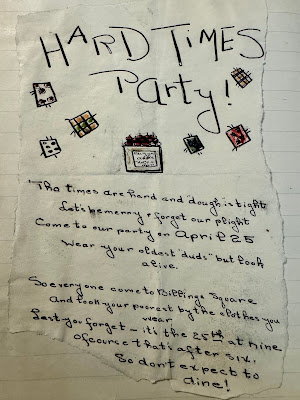
Undated Invitation to the "Hard Times Party!" at Billings Square Branch, Billings Square Scrapbook

During World War II, the branch's basement served as headquarters for Ward 4 of the Draft Board. 

"All Youths 18 to 20 Must Register Tomorrow," Worcester Telegram, June 29, 1942

In the aftermath of World War II, the Grafton Hill Unit 323 of the American Legion Auxiliary donated a Webster's Dictionary to the Billings Square Branch in memory of the 13 local men who died during the war.

Gold Star Mothers Honored, Worcester Telegram, May 21, 1947

The branch was always popular with children and families, as evidenced by the images below.

Undated photo from the Billings Square Branch

Clipping in the Billings Square Scrapbook, Summer 1936

"Summertime, And..." Worcester Telegram, September 2, 1977

Billings Square April School Vacation Program: Bike Safety, April 18, 1978

"Young Man with a Beef," Worcester Telegram, July 15, 1981

The End of the Billings Square Branch
Unfortunately, the budget cuts of the 1980s hit the Worcester Public Library hard, including at the Billings Square Branch. The Worcester Telegram article reported in its October 22, 1982 issue that the latest proposal would only keep the Billings Square Branch open three days a week for 24 hours. Proposition 2 1/2 forced the closure of all of the library branches of Worcester Public Library in May 1990 (only the Great Brook Valley Branch and the then-named Greendale Branch eventually reopened). 

The former Billings Square Branch remained vacant and sustained vandalism for several years before it was eventually sold in 1994 to a private group and was then used as a real estate office. The building now houses a hookah bar.

Sources:
"All Youths 18 to 20 Must Register Tomorrow." (1942, June 29). Worcester Telegram, p. 3.

"Attend Dedication of Branch Library." (1930, April 26). Worcester Evening Gazette, p. 2.

"Award Contract for New Branch Library." (1929, July 31). Worcester Evening Gazette, p. 21.

"Billings Square Library Opened." (1928, September 10). Worcester Evening Gazette, p. 13.

"Board Favors Branch Library." (1928, March 20). Worcester Telegram, p. 4.

"Branch Library to Be at Billings Square. (1928, July 10). Worcester Evening Gazette, p. 11.

"Branch Library Now Assured." (1928, April 17). Worcester Telegram, p. 1.

"Branch Library Opening is Held." (1928, September 11). Worcester Telegram, p. 4.

"City Dedicates Branch Library." (1930, April 26). Worcester Telegram, p. 1.

Cowan, Mrs. F. (1961). Billings Square.

"Exercises will Open New Branch Library." (1930, April 18). Worcester Evening Gazette, p. 15.

Kostopoulos, N. (1993, April 26). "Billings Square Branch Offers Being Accepted." Worcester Telegram & Gazette, p. B3.

Kotsopoulos, N. (1994, June 18). "City to Sell Branch Library." Worcester Telegram & Gazette, p. A2.

Kotsopoulos, N. (2017, February 14). "Former Library Branch Approved as Hookah Bar - Residents, Building Owner Work Out Differences." Worcester Telegram & Gazette, p. A4.

"Librarian to Recommend 1-Day Cut at Tatnuck Branch." (1982, October 22). Worcester Telegram, p. 8.

"Library Branch Nears Completion." (1930, March 13). Worcester Telegram, p. 13.

"Library Dedication Tonight." (1930, April 25). Worcester Telegram, p. 12.

"Library Plans are Discussed." (1928, October 23). Worcester Telegram, p. 2.

"Miss Mooney to Head New Library Branch." (1928, August 23). Worcester Evening Gazette, p. 6.

Mooney, E. L. (1928, October 1). Copy of Report to the Board, October 1, 1928.

"Move Library Branch from Billings Square." (1930, March 12). Worcester Evening Gazette, p. 2.

"New Library Branch for Billings Square." (1928, September 6). Worcester Evening Gazette, p. 4.

"Present Dictionary as War Memorial." (1947, May 21). Worcester Telegram, p. 11.

"Publicity Drive for Library Urged." (1929, September 19). Worcester Telegram, p. 2.

"Seek to Purchase Site for Library.' (1929, March 9). Worcester Telegram, p. 4.

Seymour, S. (1985, January 27). The Story Behind the Stacks. Worcester Sunday Telegram, p. F3.

"Sketch of New Public Library Branch." (1929, August 10). Worcester Evening Gazette, p. 1.

"Summertime, And..." (1977, September 2). Worcester Telegram, p. 14.

"To Investigate Sites for Library." (1929, January 23). Worcester Telegram, p. 3.

"Vote to Enlarge Branch Library." (1928, November 27). Worcester Evening Gazette, p. 3.

Winkelhaus, J.K. (1961, April 21). "Library Branch Marks 33rd Year." Worcester Evening Gazette, p. 22.

"Young Man with a Beef." (1981, July 15). Worcester Telegram, p. 4.


Monday, July 21, 2025

Whiskers & Words: Celebrating National Kitten Day

While National Kitten Day was on July 10th, WPL Reference Staff still wanted to celebrate the cats of the library! Below are staff cats and books recommended by their owners, based on their furry one's personality or name. Click the links to see if it is on shelf or to place a hold! 


Clove

Clove 

Fun fact: Clove was named after the character in The Hunger Games. Katniss and Prim were on the table, but we ultimately decided on Clove because of her claws and her tenacity. Now at 13 years old, Clove loves to secretly play when no one is looking, acts as Food & Health Inspector in the kitchen, and stress eats when she can. 


Stevie 

Stevie

Stevie had several names prior to landing on Stevie. We cycled through May, Azula, Penelope, and Maggie. But after listening to one of my favorite Fleetwood Mac songs, the name Stevie dawned on me. Stevie Nicks played constantly in the house growing up, so it felt only natural to name my very spirited and very spunky cat after Stevie Nicks. Stevie likes to play with only yellow toys, jump scare Clove constantly, and works OT in the biscuit factory. 


Miso

Miso

Miso is a soft-spoken diva with a strong sense of personal boundaries and a deep love of sunbeams. She prefers quiet company, thoughtful conversation (via slow blinks), and sipping water only from glasses she’s not supposed to. She has a dramatic flair for vanishing right before dinner and reappearing when she hears a can open. Miso is independent, opinionated, and oddly comforting—just like her favorite book.

Keira


Fionnoula


Keira & Fionnoula 

My personal recommendation would likely be a true crime...but my cats Keira and Fionnoula both loved cuddling up with me while I read a good cozy mystery. They would recommend a series that involves mystery solving cats and magical book stores. Something like Crime and Poetry (A Magical Bookshop Mystery Book 1) by Amanda Flowers. Keira (a tuxedo cat) would recommend that series because it starred a tuxedo cat named Emerson and Fionnoula loves sleeping on books so she would recommend anything in a bookstore. 


Gigi

Gigi

Gigi is a bossy 11 year old female cat. This morning my son was petting her on the couch. He got up and went into another room. She walked over, sat outside that door and meowed loudly until my son followed her back to the couch so that he could continue to pet her there. She doesn’t put up with anything she doesn’t like and is very demanding. I think her book  recommendation would be the Agatha Raisin series by M.C. Beaton. Both she and Agatha are bossy older females with nice slender legs, but a bit stout in the middle as well as being vocal about what they want and very determined.


Esther

Esther

Esther is a very rambunctious 1-year-old who spends her days guarding her family and playing tug of war. Her favorite toy is the Kong Teaser Curlz Cat Wand, so much so she's managed to break 2 in the last 6 months. She recommends, Every Tool's a Hammer: Life Is What You Make It by Adam Savage. It's a little bit memoir and a little bit of a pep talk, plus there's an entire chapter dedicated to glue, which may or may not be helpful when trying to make your Kong Teaser Curlz Cat Wand last a little bit longer.


Clover

Clover

Clover is a 10-year-old menace who loves playing with anything string-like, biting the corners of laptops, and hogging the TV! Her favorite video to watch is a backyard livestream of birds, chipmunks, and squirrels. 


Wednesday, July 9, 2025

Fire Insurance Maps Online (FIMo)

FIMo is a searchable database of color fire insurance maps, real estate atlases, plat books, and other historical maps of Massachusetts. Commonly known as Sanborn maps, these illustrations of high-definition show building structures, construction details, past property uses and their ownership, location of roads, railroads, and many other useful information.

Genealogists, historians, preservationists and others researching cities and buildings will find these maps very helpful. You can access this resource from our databases page. In-library use is available from all of our branches while remote access requires a WPL library card.


Insurance Maps of Worcester, Massachusetts, Volume One, 1936 Sheet 18

Perform an Interactive Map Search or a Place Name Search to find map locations for towns in Massachusetts. Once you identify the map of interest, it can be downloaded as a JPEG image or saved as a PDF document to print. Each map comes with a Key which explains the map symbols and corresponding colors. If the map was revised at any time, the Correction Record would include the dates changes were made.

Key to Volume One, Insurance Maps of Worcester, Massachusetts

For help with search tools and interpreting Sanborn maps, click on the appropriate topic in the drop down menu on the top. 


If you need help researching this database, contact us at 508-799-1655, ext. 3 to speak with a librarian, or email us your question.