Saturday, September 27, 2014

September 2014 Book Recommendations

September 29, 2014 

Colorless Tsukuru Tazaki and His Years of Pilgrimage 
By Haruki Murakami 

The latest and much anticipated novel by Haruki Murakami (1Q84, The Wind Up Bird Chronicle) has hit the shelves, sold more than a million copies in Japan within its first week post-publication, and has been residing on The New York Times Bestsellers List for seven weeks and counting. I have personally fielded several requests for this popular title at the Welcome Desk. Does it live up to the hype? Well, in this librarian’s opinion, yes and no. 

Filed under YES, Murakami dreams up an engaging plot, seemingly without breaking a sweat. The titular Colorless Tsukuru is 36-year-old train station designer living alone in Tokyo. He suffered a devastating loss of friendship when his high school clique dismissed him with no explanation back in his early 20s. But, as life is wont to unfold, sixteen years later, he is forced to confront his grief and find some answers before he can move on to cultivate meaningful relationships anew. Readers will be intrigued by the mystery: Why did his friends shut him out so completely? This question alone kept me engaged. 

However, there exists much “telling” and not enough “showing” throughout the narrative. The author mentions many times that Tsukuru feels like he has no personality (hence the “colorless’ modifier), but never delivers evidence of that idea. I would argue that anyone who feels loss as deeply as this character is likely to be anything but boring. Further, it is the friends who rejected him so callously that are portrayed in a one-dimensional light, i.e., the “athlete”, the “brain”, the “artist”, and the “comedian”. Also, Sarah, the current girlfriend who issues him the ultimatum to deal with whatever is making him emotionally distant or else, comes across as calculating, aloof and in no way the type of person to either intuit a person’s dark past or inspire said person to wrestle with his demons for the privilege of loving her. 

In summary, the plot and prose will keep likely keep you flipping pages. Lingering questions, antiseptic characters and way too much detail about designing trains keep me from recommending this book wholeheartedly. But give it try! 

--Christina

September 22, 2014 

Nordic Art: The Modern Breakthrough 1860-1920
Edited by David Jackson 

The cover, a detail of Finland’s noted artist Askeli Gallen-Kallela’s 1901 painting Lake View, pulsing with colors of Finland and the Nordic regions, is a perfect choice to represent this catalog of the 2012-13 exhibit of the same name at the Groninger Museum in Munich. The title refers to a cultural movement, Modernism, which affected all areas of northern culture in the late 19th and early 20th centuries. Jackson’s opening essay about the movement is extraordinary in its breadth and depth as he explores its impact on Nordic art, French and Paris influences on Nordic painters, and the nationalistic sense many artists developed “…without degenerating into insular chauvinism or xenophobia.” The essays are heady, educational, analytical, informative, and exciting to read. The book is large format and the reproductions – and there are many - are beautiful and inspiring to view. 

The format of the book incorporates a timeline to put world events, the world art scene, Nordic events, and the Nordic art scene in a rich contextual environment that helps to make sense of the flow of the movement. There is also a biographical section for each artist represented in the book, with each painting reproduction and page number listed. When all is said and done, it is the paintings that “talk”: landscapes, portraits, scenes from life, and fantasies. If you do not know a great deal about Nordic art – as I did not – then this book is a rich, rich reward of discovery. Some names you may know of, such as Anders Zorn and Carl Larsson. But many may be new and open up possibilities.


--Bill

September 15, 2014 

Outlander
By Diana Gabaldon 

Diana Gabaldon’s classic time-traveling adventure defies categorization. While it’s billed as romance, it could also be called fantasy, sci-fi, or historical fiction. Outlander contains elements of all of these genres. The book follows Claire Randall (or Beauchamp) a World War II nurse who is transported back in time when she steps through a ring of standing stones in the Scottish Highlands. She falls 200 years into the past landing in 1744, where she confronts her husband’s villainous ancestor, Black Jack Randall, and connects with dashing highlander, Jamie Fraser. Claire uses her spotty memory of history to help her survive, while desperately clinging to the memory of her husband and trying to resist Jamie’s muscles and charm. 

So, a little corny—but great escapist literature. Since the Starz adaptation started airing last month a lot of people have hailed Outlander as a feminist version of Game of Thrones. While I don’t think we can compare Gabaldon’s series with Martin’s (they’re completely different things), I agree with the assertion that Claire is a feminist heroine. Claire is transported into a highly misogynistic time and society. Almost immediately after arriving she is assaulted and then kidnapped. Rape is a real and constant threat throughout her ordeal. Despite these trials she is intelligent, funny, and able to adapt. What I love about Claire is that she is a real strong female character (as opposed to the Strong Female Character) yet she’s allowed to be sensual and fall in love and have doubts and make mistakes, and that doesn’t compromise her as an independent and powerful person. 

Gabaldon’s story is engrossing and thrilling, and her writing is lovely, if a little flowery. 

--Chelsea
September 8, 2014 

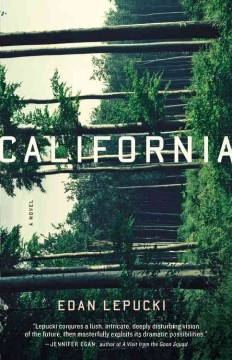
California 
By Edan Lepucki 

 If you enjoyed Margaret Atwood’s Oryx and Crake trilogy and/or conjecturing what post-apocalyptic existence in America would look like, consider reading Edan Lepucki’s debut novel California. Protagonists Frida and Cal, a Los Angeles couple who have escaped the looted, burned-out, pirate- patrolled metropolis, eschew what passes for community and head into the wilderness by themselves. Having fallen in love when Cal was enrolled at an elite avant-garde school for survivalists with Frida’s dangerously charismatic brother Micah as a roommate and best friend, the spouses believe they can endure loneliness, hunger, and extreme deprivation relying only on each other. And so they do, in an abandoned shack, largely relying on Cal’s farming and hunting skills. Until Frida becomes pregnant. 

Suddenly, their isolation seems less romantic than ominous. The rumor of other mavericks living in a secret, possibly violent community a few days’ hike away, brought to them by mysterious trader August, peaks their interest as the reality of bearing and raising a child becomes clearer. Although cautious Cal is reluctant to approach the well-guarded community, Frida’s adventurous spirit prevails and off they go. While some answers from their shared past are answered upon their arrival in this cloistered society, far more questions arise and their idyllic union threatens to become extinct. 

This novel starts off very strong. Told in a back-and-forth style, providing the reader pertinent background as the plot progresses, main story is set against a backdrop of world-changing events. According to Lepucki’s imagination, it’s the weather that’s ultimately going to do us in, i.e., an uber-blizzard that permanently takes out the Northeast. Although this reviewer felt the story’s latter half to be a bit tedious and predictable, many reviewers disagree. For sure, Lepucki is definitely an author to watch. 

--Christina


September 4, 2014

(Milan: Skira, 2012. ISBN 9788857213736) 

This is actually a catalog of an exhibition held at the Palazzo delle Esposizioni, Rome, Oct. 11, 2011-Jan. 8, 2012. There are multiple contributors to this book which includes essays by various scholars and is to an extent an attempt to contextualize what is known in Soviet art history not as an aesthetic movement but rather a reflection of totalitarianism. The book has beautiful reproductions of Russian art but most of the paintings discussed have political underpinnings and are analyzed with that theme in mind. It is dense writing, as this long quotation from the publisher foreshadows:

"Socialist Realism was and remains an exceptional phenomenon in twentieth century art. It bore the challenge of promoting realist figuration on a scale without parallel in the rest of the world, employing the talents of thousands of artists over decades and spreading over an immense and varied empire. By glorifying the social role of art, affirming the primary value of content as opposed to form and restoring the central role of traditional practices, socialist Realism was the declared opponent of the modern movement, and in fact represented the only completely alternative artistic system. Socialist Realism. Soviet painting 1920-1970 is the most exhaustive exhibition on Soviet realist painting ever shown outside Russia and follows the movement's development over fifty years through a selection of works from the country's leading museums. Created by the great Russian artists (Deineka, Malevic, Adlivankin, Laktionov, Plastov, Brodskij, Korzhev) the works present a multiplicity of questions, themes and formal approaches to art spanning from the last phases of the civil war to the beginnings of the Brezhnev era, stopping at the early 1970s when trends in official Soviet art took on varied and inconsistent directions such that the cultural supremacy of the socialist-realist current faded definitively. A non monolithic view emerges, in which the movement does not originate exclusively as the product of totalitarian control and political pressures but as an evolving organism that reflected internal issues and echoed the great historic events of the twentieth century."

The book provides an important and critical look at the impact of Russian policies on artists and the influences on artistic development. One very interesting interview is Zoya Katashinskaya’s of the artist Geli Korshev about his life as an art student before and during World War II. Best known for his mammoth work Scorched by the Fires of War, Korshev answers his interview questions in telling detail and humanity. The fact that art students were able to function at the level they did is amazing.  A separate essay on Scorched by the Fires of War by Michael Brown is another “must read” part of this fascinating book.


--Bill

Monday, August 25, 2014

August 2014 Staff Book Recommendations

August 25, 2014 

Elizabeth is Missing
By Emma Healey 


This poignant debut novel is equal parts whodunit and a meditation on memory. It is told from the perspective of an 82 year-old woman suffering from increasingly severe dementia. This narrator, Maud, is living on her own at the beginning of the novel, but a “carer” comes frequently to assist her. She relies on handwritten notes to remember things, but still constantly repeats herself to her daughter and makes cup after cup of tea without drinking it. Many of the things she repeats seem senseless at the time, such as asking where the best place to plant summer squash is, but reveal their startling origins in the end. 

The plot of the novel jumps back and forth in time from the present to Maud’s childhood in war-torn England, and to the disappearance of her older sister, Sukey. This tragic event defines her life in many ways, something she may not fully realize until 70 years later, when she finds herself still investigating. In the present, she is also concerned for an elderly friend, Elizabeth, who she hasn’t heard from in some time. She becomes relentless in her search for Elizabeth, despite her inability to always remember why she is looking for her, or who she is. She goes to her house several times, even sneaking inside once, and also finds out how to contact her son, who she suspects. In her parallel world of memories, she is still looking for her sister, trying to investigate from the disadvantage of childhood. She looks for clues everywhere she goes, collecting ticket stubs and pieces of broken shells in the dirt, and using her naiveté as a screen through which to interview everyone around. 

The characters of the town, their ways of coping with the war, and the town's extreme rationing lend a fascinating historical element to this already rich story. I recommend this book to anyone who is interested in nontraditional mysteries or psychology. The texture of Maud’s confusing world is terrifying at times, as a possible eventuality for ourselves or our loved ones, but it also has a lyricism to it that reminds us of the magic of everyday routines. Once you start reading, you won’t be able to put this down. 

--Katie

August 12, 2014 

Inside of a Dog
By Alexandra Horowitz 

“Few celebrate a dog who jumps at people as they approach--but start with the premise that it is we who keep ourselves (and our faces) unbearably far away, and we can come to a mutual understanding.”

Ever since I adopted my dog, Zoe, back in March, I’ve been spending an increasing amount of time in the 636.7 section of our non-fiction stacks. For those uninitiated into the cloistered society of Dewey, that’s the dog book section. Zoe, like all dogs, is partly a mystery. What is she thinking behind those knowing eyes? Does she have thoughts like we do, or is her cognition more of a disarray of olfactory and visual impressions? Can Zoe sense my emotions? Anyone who’s lived with and loved dogs knows that they inspire devotion and fascination in their human companions. Although it’s impossible to learn the truth of a dog’s internal life straight from the source, Alexandra Horowitz gives us her best guess at what it’s like inside of a dog.

Horowitz begins by establishing her credentials. She’s an ethologist, a studier of animal behavior, specializing in canine cognition. More importantly she is a dog person. She peppers this edifying book with personal anecdotes of her beloved dog, Pumpernickel (“Pump”). These stories form the heart of the book. Once we’ve read about the mechanics of a dog’s nose, including the boggling vomeronasal organ (read mega-nose), we then read about the snuffling nose-nudges that Pump used to wake her sleepy human each morning. The book is packed with fascinating illuminations of the dog’s inner life and explains some common befuddling dog behaviors including why they kick and scratch the ground after urinating and what those playful downward-facing-dog poses are all about. Most notably, Horowitz gives readers a glimpse at the dog’s umwelt, “their subjective or ‘self-world.’”

The author also provides her best advice for dog owners: allow your dogs to be dogs. They don’t need to be washed everyday nor should they. Smell is the most important aspect of a dog’s sensory world and it makes up a huge part of their self-identity. They’re dogs…they’re going to bark and sniff butts and do all those doggy things that seem baffling to us (but hopefully not so baffling once you’ve read this book). This is a must read for all dog lovers.

--Chelsea

August 4, 2014 

Watercolor for the Serious Beginner 
By Mary Whyte 

Watercolor for the Serious Beginner is an excellent instructional introduction to this artistic medium. The author is an accomplished and well known painter, especially in South Carolina where she resides, working mostly in watercolor. Educated at the Tyler School of Art at Temple University, she has published books of her paintings, instructional DVDs, and given numerous workshops. 

This particular book is concise and focused. The chapters are divided into materials, fundamentals, starting, still life, landscape, and figures and portraits. Each section gives pointers on techniques and examples of paintings employing those techniques – both her works and those of other painters. The book contains ample demonstrations which a student can follow. She is admittedly influenced by the work of Winslow Homer and John Singer Sargent, two watercolorists certainly at the top of that game. The WPL has Whyte’s Working South : Paintings and Sketches in its own collection. This is an excellent mirror of her skills and philosophy as an artist. 

Whether a serious beginner or an experienced watercolorist this book will have something inspirational for you. The other artists she uses as examples might lead to new discoveries and as she points out, “To create a work of art that is refreshing, imaginative, original, and even surprising, you must reach from within. This is not always as easy as it may sound, since it requires you to know yourself well and identify what truly moves you.” 

--Bill

Monday, July 28, 2014

July 2014 Staff Book Recommendations

July 28, 2014 

All the Light We Cannot See 
By Anthony Doerr 

Marie-Laure LeBlanc and Werner Pfennig are two children growing up during World War II whose lives will intersect in 1944 during the Allied bombing of Saint-Malo. Marie-Laure is a curious and dreamy blind girl whose childhood is spent exploring Paris’s Museum of Natural History where her father works as the head of security. Werner is gifted and inquisitive and lives with his sister, Jutta, in a German orphanage until he is selected to attend an elite government school where he is promised answers to his scientific questions, but also told that his mind is dangerous, independent and subversive. 

This novel is rich in symbolism and written in a lyrical, thoughtful tone. Doerr deals with heavy subjects and writes with great detail while remaining abstract about his character’s inner lives. Despite this, the novel is highly readable. Doerr calls his decision to break up the novel into short (two or three page) chapters a “gesture of friendliness” to the reader (http://www.powells.com/blog/interviews/anthony-doerr-the-powells-com-interview-by-jill/). The short chapters aren’t the only thing helping the reader to speed through this thick book. Doerr’s plot is thrilling. Jumping back and forth between 1944 and earlier years, Doerr keeps his audience anticipating the eventual merging of the timelines, when Werner and Marie-Laure will finally cross paths. I found myself at times clutching the book in desperation and at other times staring into space contemplating a poignant sentence. 

This novel will leave you haunted, which is appropriate considering that many of its characters are haunted themselves. Marie-Laure hears her father’s voice in her head advising her during moments of terror. Sergeant Major Reinhold von Rumpel is obsessed with the legend of the fabulous gem he tracks throughout Europe, especially its supposed gift of longevity. Werner cannot escape the image and voice of his sister, Jutta, who becomes his belabored conscience while he is being indoctrinated at school. And then there is Marie’s uncle, Etienne, who suffers from PTSD after watching his brother die in his arms during the first World War. 

Moving, thrilling and fulfilling, this is a great summer reading pick. Read it if you like literary or historical fiction with the smallest dash of magical realism.

--Chelsea

July 21, 2014 

Lexicon 
By Max Barry 

The online comic strip xkcd.com once had a strip where a man tells his female companion to bring him a sandwich. The woman tells the man to get himself the sandwich. The man then says, “Sudo, get me a sandwich” and his companion immediately gets does so. We are to believe that “sudo” is a magic word; you only need to precede your demands with this word-of-power and everyone will obey you. 

The plot of Lexicon expands on this idea. We are not all susceptible to the same “magic” word or words but, by analyzing an individual’s psychology, a secret organization can classify a person by “segment”, and with that knowledge, take over his mind. And they do this by asking you five simple questions: 

 •Are you a dog person or a cat person? 
 •What’s your favorite color?
 •Close your eyes and pick a number from 1 to 100
 •Do you love your family? 
 •Why did you do it? 

But Wil seems to be immune to every segment’s power words. Nobody knows why that is so, but everyone is hunting him, and using deadly force. Emily, on the other hand, is just the sort of person this shadow organization wants to recruit into their stable of “poets”: highly persuasive young people who can be taught neuropsychology and linguistics, with the ultimate goal of using the poets to control the world. 

One thread of the story follows Wil and the other follows Emily. The reader knows that their lives and the action will converge at some point, and as the body count grows, the sense of anticipation and tension also grows, exponentially. The action is non-stop, the characterization is well-done, and the suspense is a killer. 

If you only read one book this year, Lexicon ought to be it. Not a perfect book - this reader has some issues with the ending - but nearly so!

--Melody

July 14, 2014 

The Last Kind Words Saloon 
By Larry McMurtry 

The climatic shooting incident at this book’s conclusion supposedly lasted 30 seconds, and it involved names that have since morphed into iconic Western lore. Fittingly, the author also shoots the reader right in the heart at the end of this novel and you, the reader, must decide if this is a good or a bad thing. 

The Last Kind Words Saloon by Larry McMurtry (Liveright Publishing Corporation, 2014) is another memorable story of America’s mythic West brought to life in empathetic, unheroic but very human terms. McMurtry again proves that he is the literary master of the Western fiction genre, and the astute choice of the jacket art, the painting “The Fall of the Cowboy” by Frederic Remington, the master of Western art, foreshadows the nostalgic sense that permeates the book. 

McMurtry’s West is one where even legends are basically and simply human beings. This novel is short, perhaps approaching a novella. The dialog is almost truncated but the characters are still sharply drawn. If there is anything in the novel dealing with aiming and hitting a target, McMurtry certainly has a good bead on the West. His women would be “victims” by today’s standards and the men would be “abusive”, but this is the wild, wild West and McMurtry boldly populates it with whores, gamblers, thieves, lawmen, rustlers, ranchers, bartenders, settlers, Indians, and life, death, and love. And weather and geography populate McMurtry’s world as effectively as his human characters. 

There is no need to write about plot and character, there is just the enjoyment of reading this wonderful novel. When McMurtry fires that last bullet you will have a chance to dodge it, but you won’t…just go back to the cover art and glance at Remington’s painting.

--Bill


July 2, 2014


The Vacationers
by Emma Straub

If you're looking for a new beach read this summer, look no further. Emma Straub's previous works, the short story collection Other People We Married  and novel Laura Lamont's Life in Pictures, showed her to be a master of literary stylings, but this book is meant more for pure pleasure reading. She tells the tale of a middle- class New York family on vacation in Mallorca. The mother, Franny, is a food writer, and the father, Jim, a recently "retired" editor. (The truth of his retirement comes out to the family in stages). Joining them is their daughter, Sylvia, who will be leaving for Brown University at the end of the summer, and their older son, Bobby, who has moved to Miami and is dating Carmen, a personal trainer who does not curry much favor with the more pretentious members of the family. We also have Franny's oldest friend Charles and his husband Lawrence. Each of these characters has, as you may have guessed, inner turmoil of one kind of another. Sylvia has to figure out who she wants to become in the fall while embarrasedly lusting after her Spanish tutor; Bobby has to admit his financial problems to his family; Franny and Jim are not-so-obviously unhappy together, despite it being their 35 year anniversary. Each of them get a chance to tell part of summer's tale in their own unique voice, all of which Straub describes with startling accuracy. Their character arcs are believable but, at times, heart warming. We also get delicious details of the landscape and the food of Mallorca. This is a quick, easy read that will fit in nicely in between taking dip in the pool and  a turn at the grill.


--Katie


Monday, July 21, 2014

Classes and One-on-one Assistance for Adults at the Main Library


Technology Classes

Computer & Internet for Beginners (4 sessions)
Fridays, 9:30-11 am, 3rd Floor lab

The first two weeks of this class will build your basic computer skills by teaching the parts of the computer and practicing with mouse and keyboard. The second two weeks will teach you how to go online and perform basic Internet searches. Register on the 2nd Floor Reference Desk, or call 508-799-1655 ext. 3.

Clase Básica de Computadora (4 sessions)
Martes, 1:00-2:00 pm, 3a Piso, Laboratorio de Computadora

Si necesitas ayuda con computadoras, esta clase es para ti.  Cubrimos la información más básica: cómo usar el ratón y el teclado, abrir programas, y usar el internet para buscar información. Cada mes empieza un nuevo semestre de 4 clases. Para registrarse, llame al 508-799-1655 ext. 3 o registrarse en persona en el escritorio de consulta en el segundo piso.

Open Lab with Staff Assistance (Drop-in)
Wed.  5:30 p.m. - 7:30 p.m., 3rd Floor lab

This drop-in lab designed for people who need extra computer time to work on job applications, Microsoft word documents, or those who need assistance setting up a library account, email, downloading ebooks or audiobooks. No registration required.

 Job Application, Resume, Writing and Business Help

Small Business Counseling
First Wednesday evening each month, Third Floor Study Room

A SCORE counselor provides assistance and answers questions to anyone thinking about or planning to start a business. Register for a one-hour session, or for more information, call 508-799-1655 ext. 3.
                          
College Admission Essays, Resume & Job Assistance, Research Help
Wednesdays, 5:30-8:30 p.m., 2nd Floor Ref. Desk

Assistance with writing resumes and cover letters, finding information on a topic, editing, content organization and citations.  Register on the Events Calendar on the library’s website or call 508-799-1655 ext. 3.

Introductory Grants Workshop
Fourth Thursdays each month, Main Library--Banx Room and Third Floor Computer Lab

This class is for anyone new to fundraising, non-profit grant seekers, and to members of the non-profit community. It will cover grant-seeking basics including what needs to be in place before beginning your search in the Foundation Center, one of the premier resources for grant-seekers. Pre-registration is required; register online at worcpublib.org or call 508-799-1655, ext. 3.


Citizenship Interview Preparation

Citizenship Classes
Wednesdays 5:30 - 7:30 p.m. Main Library – 1st Floor Computer Lab

This drop-in class will provide help with citizenship questions, practicing the citizenship interview, and learning about the U.S. government, U.S. history, and the rights and responsibilities of being a U.S. citizen. For more information, call 508-799-1655 ext. 3.

Arts, Crafts & Literature

WPL’s Knitting Circle 
Thursdays -starts in September, 2:30-4:00 p.m., Main Library—3rd floor Ellipse

Knitters of all skill levels and other needlecraft enthusiasts are welcome to join us.  All participants must bring their own supplies. If you would like to learn how to knit, please bring size 7 or 8 straight knitting needles and a skein of worsted weight yarn. For more information please call 508-799-1655 or visit our Events Calendar on worcpublib.org.


Open Drawing Studio
2nd and 4th Thursdays, 9:30-10:45 a.m., Main Library—3rd floor Ellipse

Create an artwork based on our still-life displays. Bring your own drawing supplies (a limited supply of pencils and sketch paper will be available). Beginners welcome, but instruction is not provided.
For more information please call 508-799-1655 or visit our Events Calendar on worcpublib.org.


Book Club
3rd Tuesdays, alternate months, 6:00-7:30 p.m., Main Library---3rd floor Ellipse

Come for a lively discussion surrounding the book selection of the month. Check with staff for title to be discussed, or to request a copy. For more information please call 508-799-1655 or visit our Events Calendar on worcpublib.org.


*Please check with library regarding holiday schedules, class cancellations or to verify dates.
For more information please call 508-799-1655 or visit our Events Calendar on worcpublib.org.

Tuesday, July 1, 2014

DrivingTests.org - MA Driver's Permit Practice Tests

New! We are pleased to present free access to Driving-Tests.org, a database where you can practice for the Massachusetts Driver Permit tests. Take these interactive practice tests and pass your exam with flying colors! No more fear of the road test!

Along with the practice tests you can also brush up your knowledge on MA road signs, fines, limits and get answers to frequently asked questions about Massachusetts Driver’s License. The tests for both Automobile and Motorcycle are available along with the Driver’s Handbook for each.

To access this Free database, go to our homepage at www.worcpublib.org and click on 
New! FREE MA Driving Permit Practice Test. 

Have fun and practice safe driving!

Forensic Mysteries


Image of item


We are having another Book Talk on Monday, July 14 from 11 AM - 12 PM at the Main Library! The subject this time is Forensic Mysteries. If you are fan of the genre, or if you are a fan of "Bones" and other TV police series, you won't want to miss it. We will have copies of recommended titles available, and please bring your own favorites to share. Everyone is welcome.


If you can't make it or want to get a sneak peek, take a look at our book list. It is live in our catalog so you can see what's available or place a hold on a book so it's ready for you to pick up.

Thursday, June 26, 2014

Powerspeak--Online Language Learning Database

Have you ever wanted to learn a foreign language but didn’t know how to start? Or were you once nearly fluent in another language but haven’t spoken it for so long you’ve forgotten almost everything you knew? Do you know any native Spanish speakers who want to learn English? Here’s a convenient solution: With a Worcester Public Library card, you can access a comprehensive online language learning curriculum with Powerspeak Languages. For FREE! 

First, visit the library's website at www.worcpublib.org and click on Online Databases in the left column. You will then see a long list of online resources available to you, categorized by subject. Scroll down to Language Learning and select Powerspeak Languages. To use Powerspeak in the library, click on the library icon. If you are not in the library, no problem. Anywhere you have an internet connection, you can log in remotely by clicking on the house icon and entering your library barcode. It’s like having your own personal language tutor available 24/7. 

Geared for adult students, Powerspeak offers training in Spanish, French, German, Mandarin and ESL for Spanish speakers. Up to 1000 interactive exercises per language are divided into six units, and each unit is comprised of interactive lessons organized into Sections entitled Activities, More Practice, and Dig Deeper. Exercises include mix-and-match vocabulary drills, grammar instruction, conversation teaching, and pronunciation practice in which you can record your voice and then compare it to how it should sound. At each lesson’s conclusion, any errors you made are reviewed. Colorful graphics abound, but the user interface is clean and simple to navigate. Your progress through the course is tracked by Powerspeak, which is encouraging; by completing a few lessons per day, anyone can greatly improve their proficiency in months or even weeks. ¿Interesado? Haga clic aquí.

Wednesday, June 25, 2014

See what others are saying about our Computer Classes

Two months ago we started a series of intermediate computer classes on various topics called Technology Demystified. We have held sessions in LinkedIn, PowerPoint, Facebook, and Gmail. Here's what some students have said:

“Very clear, patient, not rushed.”

“Good explanation of topics.”

“The LinkedIn Demystified class gave me all the information I need to proceed.”

“Katie was calm, helpful and great at answering questions. It added some more confidence to my LinkedIn abilities.”

“I learned a lot. It will help me in my work and in my life.”

During July we have three more such classes! : 

Facebook: Friday, July 11, 11:30-1 pm, 3rd Floor Lab
Explore the uses of Facebook, set up an account, find "friends," and understand privacy settings. 

Windows 7: Friday, July 18, 11:30-1 pm, 3rd Floor Lab
This class is intended for those who either have a computer with Windows 7, or frequently use the library computers.  We will teach you special tips and shortcuts on using Windows 7, including free programs to download on your personal computer to keep it running smoothly. 
Please do not bring your computer to class.

PowerPoint: Friday, July 25, 11:30-1 pm, 3rd Floor Lab
When you go to almost any lecture today, you will notice that the speakers have organized their information into PowerPoint slides. If you are working or in school, you will eventually be asked to give a talk using these slides. This class will prepare you, start to finish. The only thing left is dealing with your nervous butterflies!

Glassdoor

New! Worcester Public Library now has free unlimited access to Glassdoor, the popular career website. Through the Library Partnership Program, patrons have access to all career content on the site and do not need to set up an account. Use this website for the following career related topics:

Jobs: Search more than 15 million jobs and apply for specific ones. Set up job alerts to get new and relevant jobs sent to your inbox. In addition to full and part-time jobs you can also find internships, contract and temporary jobs.

Salaries: Found a 
company you are interested in working for? Browse company-specific salaries, bonuses, and other compensation details to see if this will be a good fit for you. 

Interview Questions: Research actual interview questions and details posted anonymously by employees.


Company Reviews: Read company overviews and ratings including pros and cons of working for a particular employer. Learn about employee ratings on culture, benefits, and other benchmarks of a particular company. 


For unlimited access to Glassdoor through the Library Partnership Program, go to Worcester Public Library's page on Employment resources and click on the Glassdoor image!

Monday, June 16, 2014

June 2014 Staff Book Recommendations

June 23, 2014

J.M.W. Turner 
By Peter Ackroyd 

J.M.W. Turner is a short biography in Ackroyd’s Brief Lives series. J.M.W. (Joseph Mallord William) Turner was born to a barber and butcher in London in 1775 and went on, in a remarkably long, varied, and busy career to become a master artist who used light and atmosphere as no one had before him. 

Ackroyd chronicles Turner’s life in a linear fashion and sheds light on Turner’s private and familial struggles. Turner’s mother Mary, a butcher, was known for her temper and was eventually confined for life in an asylum while Turner was still a young man. It was a topic he never spoke about and it may have had a bearing on Turner’s decision to not marry. He preferred to live with a partner and had some relationships – rather stable ones – during his life. He had two daughters out of wedlock. His father William became Turner’s confidant and assistant in the business of Turner’s studio and gallery. Ackroyd stresses the importance of Turner’s travels in England, Scotland, and Europe, particularly Venice, in his development as an artist and his romantic and spiritual views about nature and the classical views of nature. Turner composed thousands of drawings in his sketchbooks, some of which became iconic paintings or watercolors and etchings. 

The Peabody Essex Museum in Salem currently has a major exhibit, Turner & the Sea, which contains oils, watercolors, and his sketches and studies. It was his use of light and atmospheric effects that made his reputation and this is very obvious looking at his work. His personality seems to have been gruff – he was secretive, never spoke very much, and had a reputation as a very, very parsimonious and commercially-oriented person when it came to his work. However, his talent was undeniable. 

Ackroyd’s biography is – and I used it as such before visiting the exhibit – a good jumping off point to learn something about what made Turner tick and what his life was about. It is also an excellent base for more detailed biographies about Turner. 

 --Bill

June 16, 2014

An Untamed State
By Roxane Gay


The national conversation on violence against women came to a head recently after the tragic murder of six people in Isla Vista, California. News media blew up with stories of the murderer's misogynist manifesto, and thousands contributed their personal stories of sexual assault and harassment on Twitter with the hashtag #yesallwomen. This happened soon after Congress announced plans to crack down on sexual assault in colleges. Statistics show that one in five women are assaulted during their college career. Sexual assault and sex trafficking is an even bigger problem in the developing world. Women's stories need to be told. The unique, heartbreaking novel An Untamed State is one example of such a story, although it is also much more than that. 

Mirielle is a complex main character and narrator. She was raised in America to successful Haitian parents. Her father was obsessed with excellence and very demanding of his children, especially Mirielle, the youngest. After she and her siblings are grown, her parents move back to Haiti and start a construction company. They live in a lavish mansion in a place of abject poverty. Mirielle stays behind in the States and studies hard to become an immigration lawyer. She is a strong, sometimes difficult woman who does not expect the fairy tale that her life becomes when she falls in love and becomes pregnant. 

The novel begins with Mirielle's adduction in front of her father's Haitian estate. Kidnapping is common in Haiti, and her father immediately hires a negotiator and expects she will be treated well until she is ransomed. Mirielle fights the kidnappers as hard as she can, refusing to cooperate with their dehumanizing demands, and they repay her with shockingly brutal rape and abuse. Her time in their cage is prolonged by her father’s proud refusal to pay. I will say that much of this novel is difficult to read. However, it is also a testament to the human spirit and a compelling, moving story that will keep you up all night. Mirielle's experience as a survivor in Miami, rebuilding her sense of self and family, is told with startling detail. Highly recommended for all readers, especially those interested in contemporary global issues and immigrant experiences, PTSD or mental health. 

 --Katie

June 9, 2014


John Green’s The Fault in Our Stars: Book v. Movie

“Whenever you read a cancer booklet or website or whatever, they always list depression among the side effects of cancer. But, in fact, depression is not a side effect of cancer. Depression is a side effect of dying.”

Spoilers Ahead!!

For the last few months any time a patron under the age of 18 has approached the reference desk I’ve been pretty well able to guess what it is they’re looking for. The Fault in Our Stars, John Green’s 2012 novel, has recently seen resurging popularity with the release of the film adaptation. Green was already a Printz award-winning author at the time of TFIOS’s publication, but this novel was a transformative step forward for the young adult writer. We’ve been thrilled that the novel and movie have inspired young people to read.

The book is the story of Hazel Grace Lancaster, a sixteen year old girl living with stage four cancer. Her prognosis is terminal, but the medication she’s on has so far succeeded in extending her life beyond doctors’ expectations. Hazel lives a mostly isolated life before attending a cancer support group where she meets her great love, Augustus Waters, a cancer survivor who’s in remission at the novel’s opening. The really important thing to remember about this book is that it spurns the traditional tropes of “sick-lit.” Hazel’s experience confirms that the Hollywood myth of the strong and noble cancer kid suffering through terminal illness with a smile is fallacious.


Green tells an honest, funny story about two precocious teens living with pain, never flinching away from revealing the indignities of sickness. Although the film is very true to the book in terms of plot details, it felt to me that the soul of the novel was lost in translation. Green shows us the daily realities of Hazel’s sickness: hooking up to a breathing machine every night, cheeks puffed up as a side effect of her medication, the constant, aching awareness of her lungs struggling to fill. The movie, perhaps unavoidably, glosses over these details. We don’t get to watch Hazel scrolling through the Facebook page of Gus’s ex-girlfriend, who died from a brain tumor which transformed her personality. We also don’t see Hazel’s reaction to finding Gus, incoherent and weakened, lying in a pool of his own urine during the late days of his cancer. We don’t hear support group leader, Patrick, read the growing list of those members who have passed away. Instead the movie, perhaps necessarily because of its format, succumbs to the glossy, Hollywood sad story structure that the book confronts and spurns.

Not to be all whiny or anything. The film certainly had its bright spots. Laura Dern as Hazel’s mother was absolutely wonderful. The confrontation of Peter Van Houten and the Anne Frank House scene were both spot on. Watching Hazel struggle up the stairs, carrying her oxygen tank on her back, and hearing the words of Anne Frank, another child who struggled with the pain and cruelties of the world, was the shining point of the movie. In the end, I guess I’ll conclude as I usually do when talking about a book-to-film adaptation: make sure you read the book first! The movie is good, but the book might change your life.


--Chelsea


June 2, 2014

 
How the Hot Dog Found Its Bun

By Josh Chetwynd


How the Hot Dog Found Its Bun: Accidental Discoveries and Unexpected Inspiartions That Shape What We Eat and Drink is one long title for a book that is relatively short but very much fun to read. Written by Josh Chetwynd with illustrations by David Cole Wheeler, this book is a collection of the origins of common food and drink items (and also kitchen utensils) we consume and often take for granted, from buffalo wings, to popsicles, to Kool-Aid, to paper towels and many, many more products. Chetwynd’s book is divided into categories such as Starters and Small Plates, Main Courses, Desserts, Candies and Snacks, Additives and Extras, Drinks, and Kitchen Inventions and Innovations. His anecdotes are comical, weird and serious – often all at once.

For example, the tale of tabasco sauce, also the subject of a recent Sixty Minutes segment, is an interesting enterprise that rose from the ashes of the Civil War. The McIlhenny family had lost all their land and crops on Avery Island in the Civil War except for some Mexican capsicum peppers. When McIlhenny returned to Avery he took the peppers, mixed them in salt from his island salt mines, added vinegar, combined them in an old cologne bottle and liked the result. He wanted to call it “Petite Anse Sauce”, since Avery was also known as Petite Anse, but after objections to using the family property’s name, he settled on “E. McIlhenny Tabasco Pepper Sauce”.


The idea for the name twinkies, by bakery manager James Dewar, came from seeing a billboard advertisement in St. Louis for Twinkle Toe Shoes, which he shortened to “make it a little zippier for the kids”. They were originally stuffed with strawberries so were available only seasonally. He switched to bananas since they could be found year round but rationing in World War II forced Hostess to switch to the vanilla flavored filling familiar today. The Twinkie segment does refer to the infamous “Twinkie Defense” used in the San Francisco Moscone and Milk murders in 1978. So, if you occasionally enjoy browsing this type of background information about common products ,sit back and grab a Twinkie - but maybe not a Graham cracker. You’ll have to look at this book to find out why!


--Bill


Tuesday, June 10, 2014

Credo Reference


Have you tried using Credo Reference for your research needs? Credo is an online reference library providing full-text access to over 500 reference books in various subjects from several publishers. Whatever your research topic, you will find information here to help you. Need a definition? An Image? Need help pronouncing a difficult word? Or need a famous quotation to kick off your research paper? Use this database to find quick answers to these questions. 


Use basic or advanced keyword search to find articles, images and maps. Reference materials such as dictionaries, thesauri and encyclopedias cover subject from Art, Business, Geography and History to Science, Technology and Zoology. 


Click on Find a Book to a complete list of title that are available. Use Find Topic Pages to get an overview on any topic. Over 10,000 topic pages are available to get you started on any topic. Once your research is completed, you can print, email, share and export your findings so they will be available for you at a later date. 

To access the database, go to www.worcpublib.org and click on online databases in the left column. Click on Credo Reference under Quick Access. A valid Worcester Public Library card is needed.

Monday, June 9, 2014

Worcester Public Schools Summer Reading Lists


Summer is here! While school is out many of you will have summer reading requirements.

We've tried to make the process of checking out your required summer reading books a little easier by making lists in our online catalog. You can see what is available for your grade and put a hold on any title that is currently checked out.

Grades 7-12 have recommended reading lists; students must choose three of these, or any other three books. Click here for the fiction for grades 7-8 and click here for the non-fiction for grades 7-8.

Click here for all titles for grades 9-12.

The lists for other grades are much larger, with many options, and can be found at the Worcester Public Schools' website here.

Summer reading for school can count as summer reading for the library's program. Register here and log your reading throughout the summer to win prizes! Stop by the library for more information.